with Cydney Neil
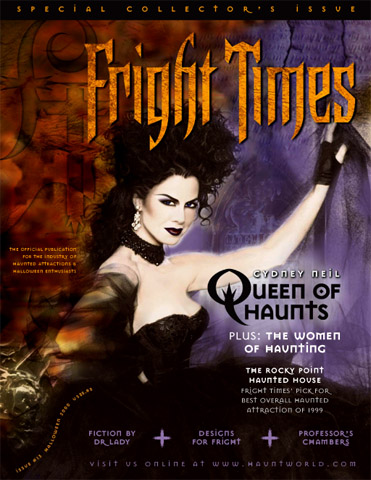 JD: First of all, Cydney, how did you get into the Halloween business? Did you start with smaller haunts?
CN: I got into the Halloween business by accident, or at least that's what it seemed. Perhaps it was all quite fateful though, as it has turned out to be the perfect occupation for me. I have learned and grown more from my experiences over the past fifteen years than any other time in my life.
Years ago, my family owned a restaurant called Rocky Point. It operated in a large stone building, which had been built by my father and had become something of a local landmark. In the late 60s, the building suffered a devastating fire and remained vacant for several years. In 1979, my younger brother, Neil—and no, his name is not Neil Neil—started a "spook alley" in the building. Because of the unique location and stone construction of the building and rumors that the long-vacant building was actually haunted, it made the perfect site. The event was immediately successful and became quite popular in just a few years. I came along in 1986 to oversee the show on a temporary basis. I had no intention of taking over the project, as I was definitely not a fan of Halloween or anything horror-related. That was fifteen years ago, and every year since, I have said that this will be my last year in the business. I am still hearing myself say that again this year. It is a bit addicting. I just haven't been able to give it up yet.
JD: What things have influenced you along the way?
CN: Unlike many other people I've met in the business, I am not a lifelong horror fan. As a result, I have had to turn to films for a lot of my ideas. Luckily, I have a strong background in production, set design, fashion, and almost every area of running a business, as well as many contacts in the film industry. My shows have become known for their realism and attention to detail. They have been, and always will be, low-gore. I honestly think my love of things beautiful has allowed me to make the darker side of things much more interesting. I also grew up with an exceptionally creative family. My father is an artist. My favorite people have always been artists. Being around creative people all my life has been a tremendous influence on my own ability to create.
JD: What makes your shows unique? How do you keep your patrons coming back year after year?
CN: I think the main feature that has separated my shows from some of the others is the level of professionalism. This is a professional production. When I started, I wanted to see the same quality of production in my haunted house as I was accustomed to in the other events I had produced.
I also think my shows are unique in that, in addition to raising hundreds of thousands of dollars for charity, they have also been financially successful since the beginning and continue to be more so every year. There are so many different aspects of this business, far beyond just bloodying up some body parts and jumping out and scaring people. Our success has come from insisting on quality in every area-from marketing and promotion, to the actual construction and design of the sets, including lighting, sound, and special effects, to the actors, the costumes and the make-up. It is all part of an overall presentation you offer to the customer. This quality presentation translates into satisfied customers who keep coming back year after year.
JD: As most operators know, this business is grueling! With such a large operation and staff to attend to, how do you keep going (and stay sane)?
CN: First of all, I am single and have no children! Second, from the beginning, I have had the capital to start and run a business. These two things give me a level of freedom and allow me to spend the time it takes to create successful events. This is my full time job. Success in what you do is a great motivator in itself to keep going. Third, I genuinely love what I do. There is tremendous variety in my job, which keeps me from getting bored. I have never done any other single thing for fifteen years! There are also a great number of people who benefit from this event. Knowing that I have the ability to shape and influence other people's lives through my work makes those truly grueling times all worth it.
JD: Have you ever been burned out? Ever thought you've had enough?
CN: Every year about a week before we open, I am always ready to give it up! And for several years my staff has heard me swear that I will never go through it again. Anyone who produces a large show with an opening night schedule looming over their head knows the pressure and the stress one goes through to meet that deadline. But once the doors are open, people start lining up, money starts coming in instead of only going out and I catch up on some sleep, I start thinking about what I am going to do for next year's show!
JD: We've all made mistakes along the way and most often learned a lesson in the process. Could you share such a learning experience with our readers?
CN: I'm sure I have made many mistakes over the years, but the one that I think has been the most consequential is not signing very specific contractual agreements with the people I work with. I have learned that if something can be misunderstood, it will be. It is not a matter of trust, it is just good business to make sure both parties know exactly what to expect from each other and when.
JD: On the flip side, what would you consider your greatest personal triumph in the haunted house industry?
CN: The first thing that comes to mind is the feeling of triumph that came the year I opened my second show in Salt Lake City. Several of my sponsors discouraged me from going up against some established haunted houses. They were worried about my ability to compete. It was a risk, but I knew I had to take it. I moved ahead with complete faith and confidence and was successful that first year. Now, nine years later, only one of those "competitors" has remained in business, and our event continues to grow! Needless to say, my sponsors were very impressed and have continued to support our event ever since. And then, of course, the good the event has done for many other people.
JD: Captain Kirk had Spock. Holmes had Watson. Who is your 2nd in command and how do work as a team?
CN: Ever since I got involved, my brother Neil and I have worked closely on the shows. I couldn't and wouldn't ever want to do them without him by my side. We complement each other-he is great at all the technical aspects of the shows, and I am best at the conceptual design and the business side. I design the shows, and he lays them out. He runs the construction crew, while I put all the other pieces together. I walk into a room we are building, and I see how the props and actors are going to fit in, while he sees the exits, the lighting, and how it will fit into the space we have. Until I sold the Ogden show this year, Neil would oversee that show once it was up, throughout the month.
Another person I consider invaluable is Bart Cox, my construction coordinator. He has been involved with my production team for three years now. The quality of my sets has improved tremendously since Bart came to work with us. He has become almost as much a part of the show as I am.
So many other people associated with our show are great at what they do. It is always a team effort. No one person can handle a project of this size without a great crew behind her.
JD: Cydney, how have you seen this industry grow in the past five years? Do you think it has peaked yet?
CN: For the past six years, I have been speaking at Transworld's Haunted Attraction Seminars in Chicago. Those seminars started out with about twenty haunters in a hotel room discussing the state of the Halloween business and sharing some ideas. This past March, there were more than 350 people who paid $300 to attend the day of seminars! The growth of the haunted attraction business has been amazing to watch. I think the biggest difference I have seen, and place where the growth has come, is in the quality of the productions. The shows are becoming much more sophisticated and the producers have finally begun to treat their events as businesses. Transworld's Halloween show and seminars have had a huge impact on us all. We have all been able to learn a great deal and have been influenced from the exposure to other haunts and haunters. Many haunters have been forced to raise the quality of their shows and become more business savvy in order to compete and succeed financially in their markets. I think we are seeing the last of the "home haunter." They just can't compete with the big budget productions, and the safety requirements are becoming too strict for them to meet. But as far as this business peaking, I think we are far from it. We are just beginning to see the haunted attraction business really take shape in this country. And there are still many countries around the world that have yet to jump on the Halloween bandwagon. There is so much potential for growth. I think all of us will be quite surprised to see what our little industry turns into over the next ten years.
JD: How would you describe the experience you are trying to create for your customers?
CN: Entertaining and complete. I try to create a variety of experiences in my shows, from great visuals to being scared, to having fun. I like our customers to become completely absorbed in whichever setting they enter. This requires playing into every one of their senses as much as possible. It is a challenge to create a 50,000 square-foot show that flows perfectly from beginning to end, but we have become very good at doing just that!
JD: Which is more important to the success of your show, actors or sets?
CN: I couldn't, nor would I want to, have one without the other. They cannot be separated. I create my sets to work with the actors, and my actors are trained to work within the sets. I think it is a mistake to spend any less time or money on one or the other. They both are critical to a successful and enjoyable show.
JD: What's the biggest mistake most commonly made by beginning operators?
CN: Not having the capital and the business sense to make the event financially successful. In order to succeed in this or any other business, you have to have money and make money. Too many people just think their life of watching horror movies and all the great ideas they have will be enough. It isn't, and never will be. Also, beginning haunters often fail to understand and comply with the strict safety requirements that apply to public events, and then find out the importance of them the hard way.
JD: Are you revered by your employees if we were to ask them on the street?
CN: I have a great relationship with all my employees and all of the actors who have been involved over the years. One of the secrets to the success of our actor program is the genuine respect and appreciation that is shown to each of them for their efforts. Many of them have become like family to me. I don't know if every one of them "reveres" me. I have high expectations of the people involved, too high for some. I do believe the majority of them respect and appreciate me in my position.
JD: What scares you?
CN: New building inspectors and, the rising cost of producing my shows, but not much else!
JD: How important is it for you to change your show every year?
CN: From a personal standpoint, it is the only way I have survived in this business for fifteen years. I need variety. I need creative challenges. I love coming up with entirely new concepts. I also think our willingness and ability to change our shows each year have been major factors in the show's continued success in the same small market for twenty years. People like to see new things and enjoy experiencing something different each year.
JD: What is the scariest thing you can do to a patron in a haunted house?
CN: After fourteen years of creating some pretty great scares, that damn chain saw still gets the most people to scream! Could someone please invent a different power tool we can use?
JD: What makes a bad haunted house? Ever visited one?
CN: Not enough props, not enough actors, poorly trained actors, no real theme or concept, no variety of experiences, too many masks, store-bought everything, too much open space, awkward transitions between sets, no sound systems, safety hazards. I have visited more than I care to remember. In all fairness, though, they are improving.
JD: What advice can you give someone just entering the haunted house industry?
CN: Find the most successful haunted house you can and work or volunteer for them for a year or two or until you are sure you have what it takes to make it in this business, and that this is really what you want to do. It is a much tougher business than most people think. JD: How important is the Internet to your business? Does it have a measurable effect on your attendance?
CN: I have a great web site, and team up with several of my sponsors on web site promotions. But I don't believe the Internet has any significance in actual attendance or the success of my show. Perhaps it will in the future, but not now.
JD: Cydney, where do you go from here? What can we expect from you in the near future?
CN: My 2000 show will be my best ever, of course. I have some big plans! I plan to host an "Open Haunted House" for everyone to come to mid-October. Watch for more information about that. I also plan to create a series of how-to videos for the haunted house industry that will be on sale at the Transworld show next March. I want to record and share some of the things I have learned through the years. And after that, well, it would only be a guess. I'm just along for the ride! And it has been a great one so far.
Copyright ©2001 Fright Times Magazine